The number on a bathroom scale can be frustratingly uninformative. Two people can weigh the same and have very different proportions of fat and muscle. Your own weight can remain unchanged while your training, eating habits and body composition change substantially. That gap between weight and progress is exactly what sophisticated home body-composition scales promise to fill.
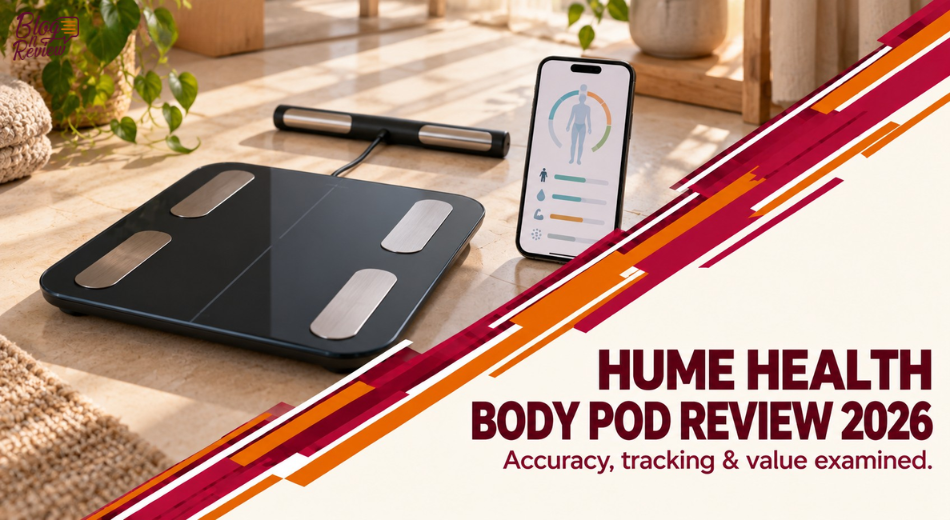
The Hume Health Body Pod takes that promise further than a basic Bluetooth scale. Its handheld electrode bar and foot platform aim to measure more of the body, while the Hume app turns estimates of fat, muscle, water and other metrics into trends you can revisit. The pitch is attractive: a more complete picture of progress without repeatedly booking an appointment at a clinic.
But the most important question is not how many numbers a device displays. It is whether those numbers are useful, sufficiently repeatable, and honestly interpreted. Hume promotes DEXA-level accuracy, yet scientific accuracy has several meanings, and a home bioimpedance scale is not a clinical DEXA scanner. This Hume Pod review examines the hardware, scanning process, metrics, app, research, real-world drawbacks and buying considerations so you can decide whether the premium is justified.
Explore the Hume Pod’s hand-and-foot scanning system, body-composition dashboard and current product options.
Explore the Hume Pod →What Is the Hume Health Body Pod?
The Hume Pod is an at-home body-composition analyzer that combines a scale with a handheld sensor bar. Hume positions it as a personal health hub, with the ability to estimate body fat, muscle mass, visceral-fat indicators, water-related measures and a collection of other health and metabolic metrics. The product page advertises 45 trackable metrics, although the usefulness and scientific status of each metric differ.
Its distinguishing feature is the hand-and-foot electrode arrangement. Many inexpensive smart scales pass a small electrical signal only between the feet and use an algorithm to infer whole-body composition. Hume adds contact points for the hands, allowing a different measurement path and segmental estimates for regions such as arms, legs and trunk.
The product is most relevant to someone who already knows that weight alone does not capture their goals. A person trying to preserve muscle while losing fat, monitoring changes during resistance training or following longer-term body recomposition may benefit from seeing consistent trends. Someone who simply wants a dependable weight reading probably does not need this level of complexity.
Hume Pod Quick Verdict: Who Is It Best For?
The Hume Pod is a compelling upgrade for people who want more detailed at-home body-composition trends than a basic scale provides. Its eight-contact hand-and-foot approach and segmental estimates are genuine differentiators. However, its results remain model-based estimates, not direct measurements of body fat or clinical diagnoses. The most defensible reason to buy it is to monitor patterns under consistent conditions, not to assume that every displayed number is an exact medical fact.
Its main compromises are price, app dependence, possible measurement errors and the temptation to overinterpret small daily fluctuations. Hume advertises a free app and optional enhanced services, but buyers should confirm which insights are included without payment. The product is less suitable for people who want a scale that works entirely independently of a phone or for those whose medical circumstances make bioimpedance use inappropriate.
How the Hume Body Pod Works: Step by Step
The Pod uses bioelectrical impedance analysis, usually abbreviated BIA. The device sends a very small electrical current through the body via electrodes and measures the resistance and reactance encountered. Because tissues and body water influence electrical properties, software can use the resulting signals along with personal information to estimate body composition.
In practical use, the process involves placing the scale on a firm, level surface, opening or connecting the Hume Health app, stepping onto the foot electrodes and holding the sensor bar with both hands as directed. A complete scan is advertised as taking less than a minute. Consistent posture, bare skin contact and correct setup matter because they can affect signal quality.
After the scan, the app presents a weight reading and estimated composition metrics, along with progress graphs and interpretive guidance. The experience is more involved than stepping on a simple scale. That extra step is worthwhile if you value the detail, but it can feel inconvenient when you want a quick morning reading without opening an app.
Eight Electrodes and Segmental Analysis: Why the Handle Matters
The Hume Pod uses contact points for both feet and both hands, an arrangement often described as eight-electrode BIA. This enables current paths that provide information about more body regions than a typical feet-only consumer scale. Hume uses the signals to report segmental estimates, including muscle-related readings for different limbs and the trunk.
Segmental data may be interesting to people who strength-train or want to notice large left-right differences over time. But the output should be read cautiously. A displayed asymmetry does not diagnose an injury, identify its cause or establish that a specific muscle group needs rehabilitation. Differences in posture, contact and algorithmic assumptions can influence the result.
The handle also introduces a practical requirement: users must position their arms as instructed and maintain good contact. In a rushed household, this makes the Pod less effortless than a standard scale. Its extra complexity is the price of getting more detailed estimated information.
What Does the Hume Pod Measure?
Hume advertises 45 health and body-composition metrics. Headline categories include body weight, body fat percentage, fat mass, lean or fat-free mass, muscle-related estimates, visceral-fat indicators, body water, metabolic-age-style scores and segmental measurements. Some app labels are calculated from other measurements rather than directly sensed by a unique physical sensor.
Body weight is the most straightforward output. Body fat percentage represents an estimated proportion of body mass attributed to fat. Fat-free mass includes much more than muscle, including water, bone and organs, so it should not be casually described as pure muscle mass. A visceral-fat score is not a medical imaging measurement of the exact amount of fat around internal organs.
Metabolic age and similar composite scores can be motivating, but they are algorithmic summaries rather than literal measurements of biological aging. Likewise, a scale cannot diagnose cardiovascular disease, osteoporosis or a metabolic disorder merely by displaying a related label. Treat the dashboard as a personal tracking aid and seek clinical assessment when health decisions require it.
| Metric | What it represents | Important caveat |
| Body weight | Mass measured by the scale | Not a measure of body composition |
| Body fat percentage | Estimated share of mass that is fat | Not identical to DEXA |
| Fat-free mass | Estimated non-fat mass | Includes water, organs and bone |
| Segmental muscle | Estimated regional composition | Not a diagnosis of muscle imbalance |
| Visceral fat | Algorithm-derived fat indicator | Not a direct medical image |
| Metabolic age | Composite app-derived score | Not biological age or a diagnosis |
Hume Pod Accuracy: What Does “98% DEXA-Level” Really Mean?
Hume uses marketing language referring to approximately 98% DEXA-level accuracy or correlation. That sounds precise, but correlation and agreement are not interchangeable. A device can rank people similarly to a reference method and still be several percentage points away for a particular individual. A claim about correlation cannot be translated into a guarantee that your personal body-fat result is within two percent of a DEXA scan.
A July 2026 medRxiv preprint evaluated the Hume Pod in 67 adults against DXA and a four-compartment reference model. It reported excellent short-term test-retest reliability and strong relationships with the reference methods. The authors also reported average absolute errors for body-fat percentage of roughly 2.6 percentage points against the four-compartment model and approximately 3 percentage points against DXA. The spread of individual differences was meaningfully wider than those averages.
That is encouraging evidence for a consumer BIA device, particularly for repeated monitoring, but the study is a preprint and had not completed peer review at the time of this article. Its sample size, testing conditions and participant characteristics also limit how confidently results can be generalized. The right conclusion is neither that the Hume Pod is useless nor that it is a portable DEXA scanner. It is a potentially useful estimator with measurable uncertainty.
For context, DEXA itself is a specialized imaging method used to estimate body composition and assess bone mineral density in appropriate clinical settings. Hume does not expose you to X-rays; it uses electrical impedance and predictive equations. Those are fundamentally different measurement technologies.
Repeatability vs Accuracy: The Distinction That Matters Most
Imagine that a scale estimates your body fat at 24% today, 23.8% next week and 23.2% several weeks later. If your routine and measurement conditions are consistent, that pattern may be useful even if a laboratory reference would report a different absolute number. Repeatability asks whether the device produces similar readings under similar conditions; accuracy asks how closely the estimates match the underlying reference.
The 2026 validation preprint found high test-retest reliability for the Hume Pod. That is a practical strength for tracking trends. Yet short-term repeatability in a controlled research environment does not mean that everyday readings are immune to hydration, meals, exercise, temperature or positioning.
Use a rolling view of several measurements instead of celebrating or worrying about a one-day shift. If you are making important clinical or treatment decisions, do not substitute a consumer-scale reading for advice from a qualified healthcare professional.
Can the Hume Pod Track Fat Loss and Muscle Gain?
This is the product’s most persuasive use case. When body weight changes slowly, estimated fat and lean-mass trends may provide additional context for someone who is lifting weights, changing nutrition or working on long-term fitness. The segmental display can make progress feel more concrete than a single weight number.
However, muscle estimates are influenced by hydration and other assumptions. A dramatic overnight increase in muscle mass is much more likely to reflect fluid shifts or measurement variability than actual new muscle tissue. Likewise, a single higher body-fat reading after a workout is not proof that your training failed.
The most reliable approach is to pair Hume’s trends with other signals: strength performance, waist measurements, how clothes fit, energy levels and, when appropriate, professional assessments. The device should add context rather than become the sole judge of progress.
Hume Health App Review: Where the Data Becomes Useful
The Hume Health app is central to the experience. It stores readings, shows historical charts and presents interpretation around body composition. The appeal is not merely the number of metrics but the ability to see whether patterns persist over time. For a dedicated user, this can be more motivating than a paper log or a conventional scale display.
The downside is dependence on the phone and software. In a June 2026 hands-on review, Wareable reported occasional failed measurements and frustration that the app needed to be opened to access advanced data. Those are practical concerns, especially if you share the scale with family members or want a frictionless morning routine.
Hume promotes a free app, while some coaching or premium features may be offered separately. Before purchasing, confirm which specific charts, integrations, historical records and recommendations are included in the free tier. App capabilities, subscription pricing and account requirements can change independently of the hardware.
Hume Pod vs a Basic Smart Scale
A typical budget smart scale is excellent for tracking body weight and may provide broad BIA-derived body-fat estimates. Its advantages are affordability, simplicity and convenience. The Hume Pod costs more because it adds hand electrodes, segmental analysis and a more ambitious software experience.
That difference is meaningful for someone who will consistently use the extra information. If you mainly want to check whether your weight is moving gradually over several months, a basic scale may deliver most of the value. Paying more for dozens of estimates is not automatically better if those metrics do not change your decisions.
When comparing devices, look at measurement method, reproducibility, app reliability, included features, warranty and long-term data access. The number of displayed metrics is a poor substitute for understanding how the measurements are generated.
Hume Pod vs DEXA and Professional Body-Composition Testing
DEXA and multi-compartment laboratory methods offer more controlled reference measurements than a consumer BIA scale. Professional testing may be appropriate when a clinician needs specific information or when an athlete wants a periodic benchmark under standardized conditions. Such testing is not always necessary for ordinary wellness goals.
The Pod’s advantage is convenience: you can measure at home repeatedly without appointments. The trade-off is uncertainty around absolute values. A sensible hybrid approach for some users is occasional professional testing for context and consistent at-home readings for general trends, while recognizing that the methods will not necessarily agree on every number.
Never use the Hume Pod to self-diagnose bone loss, heart conditions or other medical problems. A displayed bone-related or visceral-fat-related metric is not a substitute for a validated clinical assessment.
Price and Value: Is the Hume Pod Worth $229?
Hume’s official product pages displayed a promotional price of $229 in US dollars, with crossed-out reference prices varying by landing page, including $352 and $366. Some pages also displayed additional promotional claims or discount unlocks. Because those offers differ across pages and can change, treat $229 as an observed advertised price rather than a guaranteed checkout total.
At that level, the Hume Pod is a significant step above inexpensive weight scales. Its value is strongest when the hand-and-foot analysis, segmental trends and app genuinely support a routine you plan to maintain. It is harder to justify for a person who checks weight only once a month or who expects every number to have medical-grade certainty.
The total cost should include any optional paid app features, taxes, shipping, warranty limitations and the effort of using the device consistently. A lower upfront price is not a bargain if the feature you want requires an unexpected recurring payment.
| Buying question | Hume Pod | Basic smart scale | Clinical DXA |
| Main purpose | Home composition trends | Weight and rough estimates | Periodic reference assessment |
| Typical method | Hand-and-foot BIA | Usually feet-only BIA | X-ray-based imaging |
| Segmental insights | Yes, estimated | Often limited | Depends on report |
| Convenience | Home, repeated scans | Home, very simple | Appointment required |
| Key limitation | Estimate error and app dependence | Less regional information | Cost and access |
Review the full specifications, included app features and current checkout price before ordering.
View Hume Pod Details →Hume Pod Pros and Cons
The product has a stronger technical case than a generic scale that simply advertises a long list of metrics, but it also introduces expectations that need careful management. The following comparison separates the practical advantages from the limitations that matter most when buying.
| Strengths | Trade-offs |
| Hand-and-foot electrode design | Not equivalent to a DEXA scan |
| Segmental body-composition estimates | Hydration and timing affect results |
| Detailed long-term trend dashboard | Advanced experience depends on the app |
| Promising repeatability in a 2026 preprint | Study not yet peer-reviewed |
| More information than weight alone | Premium price compared with basic scales |
| At-home convenience | Occasional scanning errors reported |
How to Get More Consistent Hume Pod Readings
Consistency begins before stepping on the scale. Choose a stable, level floor rather than a soft rug, and try to measure at roughly the same time of day. Many users find a morning routine after using the bathroom and before breakfast easiest to repeat. Follow Hume’s instructions for bare feet, handle placement and correct posture.
Large meals, strenuous exercise, alcohol, dehydration and major fluid shifts can affect impedance-based estimates. Avoid comparing a reading taken after a hard workout with one taken after a restful morning and assuming the difference reflects real tissue change. Use the same device, similar conditions and a long enough time window to see a pattern.
If the scale repeatedly fails to scan, check the battery or charge status, app permissions, Bluetooth connection, electrode contact and available software updates. Persistent problems are a reason to contact support while you are still within the applicable return window.
Safety: Who Should Ask a Clinician Before Using BIA?
Bioelectrical impedance devices pass a small electrical current through the body. People with implanted electronic medical devices, such as certain pacemakers or defibrillators, should not assume the product is suitable without checking the manufacturer’s contraindications and obtaining medical advice. Pregnancy and other medical circumstances may also affect the suitability or interpretation of readings.
Even when use is permitted, the body-composition estimates are not a substitute for medical diagnosis or treatment decisions. If tracking numbers is causing distress or encouraging unhealthy behaviors, it may be better to focus on broader wellbeing indicators and discuss measurement frequency with a professional.
Always follow the current official safety manual for the exact hardware version. Do not rely on a generic description of smart scales when deciding whether the electrical measurement method is appropriate for you.
Customer Reviews and Independent Hands-On Feedback
Hume’s product pages displayed a very large on-site review count—more than 48,000—and an average around 4.8 out of 5. Such figures indicate a substantial body of brand-hosted feedback, but they do not independently establish scientific accuracy. Reviews can mix impressions of shipping, packaging, usability and perceived progress with claims about the underlying measurements.
Independent hands-on reporting offers a more nuanced picture. Wareable praised the depth of information and found weight readings plausible, but reported occasional scan errors and frustration with app dependence. Its reviewer did not claim to verify absolute body-fat accuracy against DEXA. Some online users also describe differences between their Pod readings and clinical scans; individual anecdotes can raise useful questions but cannot establish a universal error rate.
When reading reviews, prioritize comments about setup reliability, repeated measurements, support responsiveness and the ability to export or revisit data. Be skeptical of any testimonial claiming a device directly caused rapid fat loss or muscle gain. A measurement tool may inform behavior, but it does not produce those physiological changes on its own.
Shipping, Returns, Warranty and Subscriptions
Hume’s landing pages advertise free shipping in some regions and a 45-day refund or trial policy. However, the precise conditions, start date, exclusions, return-shipping responsibility and treatment of opened products should be verified in the current checkout and policy documents. Promotional landing-page summaries are not a substitute for full terms.
The same caution applies to warranties and subscriptions. Check the warranty period for the exact model, whether registration is required and what counts as a manufacturing defect. Confirm whether the functions that motivated your purchase are included in the free Hume Health app or require optional membership.
If you are ordering internationally, verify shipping availability, import duties, supported app regions and local return arrangements. The ability to receive the product is not necessarily the same as the ability to return it economically.
Who Should Buy the Hume Body Pod—and Who Should Skip It?
The best buyer is someone who wants to follow body-composition trends for months, is comfortable using an app and understands that BIA readings are estimates. Strength-training enthusiasts, people focused on body recomposition and data-oriented wellness users are plausible matches. The hand-and-foot design gives them information that a conventional feet-only scale may not provide.
The Pod is less suitable for buyers who only need weight, dislike managing apps, expect a diagnosis or want a guarantee that their body-fat percentage will match a DEXA scan. It is also not an appropriate impulse purchase for someone who may be medically advised against bioimpedance measurements. Decide what question you want the device to answer before paying for it.
Final Verdict: Is the Hume Health Body Pod Worth It?
The Hume Pod offers a genuinely more ambitious home body-composition experience than a basic smart scale. Its hand-and-foot measurement design, segmental estimates and longitudinal app data can help committed users look beyond weight. The 2026 validation preprint adds encouraging evidence about repeatability, although it does not turn the device into a clinically exact body-fat scanner.
At an advertised price around $229, it is worth considering if you will use its trends consistently and can tolerate occasional app friction. The smartest way to approach it is as a progress-tracking companion: standardize your measurements, interpret changes over weeks rather than days, and reserve medical conclusions for qualified professionals. That balanced expectation is what makes the Hume Pod useful rather than misleading.
Frequently Asked Questions About the Hume Pod
What is the Hume Health Body Pod?
It is a smart body-composition scale with hand-and-foot electrodes and a companion app that estimates fat, lean mass and other metrics.
How does the Hume Pod work?
It uses bioelectrical impedance analysis: small electrical signals and predictive algorithms estimate body composition from hand and foot contacts.
How many metrics does the Hume Pod track?
Hume advertises 45 trackable metrics, though many are calculated estimates rather than independently measured biological quantities.
Is the Hume Pod 98% accurate compared with DEXA?
The company uses 98% accuracy or correlation language, but correlation is not a guarantee that individual readings match DEXA within 2%. A 2026 preprint found promising repeatability with meaningful individual uncertainty.
Can the Hume Pod measure visceral fat?
It provides an estimated visceral-fat indicator; it does not directly image fat around internal organs.
Does the Hume Pod measure muscle gain?
It estimates lean and muscle-related measures and can show trends, but short-term changes can reflect hydration rather than actual muscle growth.
How long does a Hume Pod scan take?
The company advertises a full scan in under 60 seconds, assuming correct setup and a successful reading.
Does the Hume Pod require an app?
The Hume Health app is central to viewing detailed body-composition metrics and trends. Check current device and app requirements before buying.
Is the Hume Health app free?
Hume advertises a free app, with some additional services potentially offered separately. Verify which features are included without a subscription.
How much does the Hume Pod cost?
Official US landing pages displayed a promotional price around $229 in October 2026. Prices and reference discounts can vary.
Can I use the Hume Pod with a pacemaker?
Do not assume BIA devices are suitable with implanted electronic medical devices. Follow Hume’s contraindications and ask your clinician.
Is the Hume Pod worth buying?
It may be worthwhile for consistent at-home body-composition trend tracking, but it is not necessary for basic weight tracking or a substitute for clinical assessment.
If you want more than a weight reading, compare the Pod’s capabilities and policies with your tracking goals.
Shop the Hume Pod →