Mowrator Review 2026: Is the S1 Remote-Control Mower Worth It?
-
September 02 , 2026
-
38
Quick Verdict
| Category | Assessment |
| Overall rating | 8.7/10 |
| Best for | Steep banks, rough ground, overgrown grass, large properties, and users who cannot comfortably push a mower |
| Main advantages | Serious cutting power, remote operation, excellent traction, long battery life, 53 cm cutting deck |
| Main drawbacks | Expensive, heavy, not autonomous, requires storage space, can mark delicate turf |
| Short summary | The Mowrator S1 combines the cutting ability of a substantial walk-behind mower with remote-controlled mobility. It is compelling for difficult terrain but excessive for a small, flat lawn. |
Mowrator Review
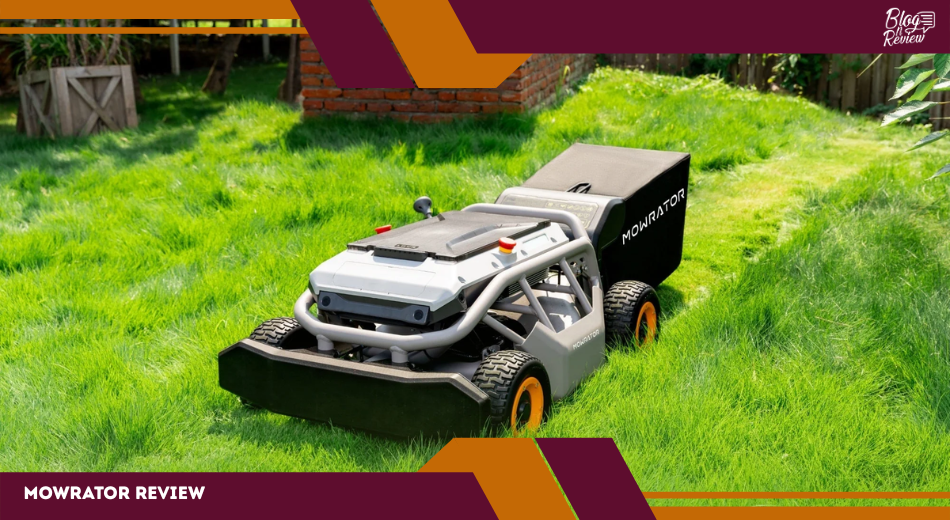
The hardest lawns are rarely difficult because of their total area. They are difficult because of steep banks, wet patches, tree roots, long grass and awkward sections where pushing a normal mower feels exhausting—or unsafe. That is the problem the Mowrator S1 is designed to solve. It looks like a robotic lawn mower, but this distinction matters: Mowrator is remote-controlled rather than fully autonomous. It does not map your garden, leave a charging station and maintain the lawn without supervision. You drive it using a handheld controller while its full-width blade cuts the grass. That approach has disadvantages. You still need to be present, concentrate and guide every pass. In return, you get far more control and cutting muscle than most compact autonomous mowers provide.
The current European 4WD model uses a 53 cm deck, is promoted for thick and tall grass, and is rated for gradients as steep as 85% with its wide-wheel configuration. Mowrator lists up to 2.25 hours of runtime from the 18Ah battery and coverage of as much as 4,500 m² per charge under suitable conditions. Our conclusion is straightforward: the S1 is one of the more convincing options for owners who genuinely need a remote-control slope mower. It is not the right purchase for someone whose main goal is completely hands-free lawn maintenance.
Check Today's Price
What Is the Mowrator S1?
The Mowrator S1 is a rechargeable, remote-control lawn mower built to tackle terrain that can be uncomfortable for a conventional push mower and too demanding for a lightweight robotic mower. Its low, wide construction keeps the centre of gravity close to the ground. Depending on the model, power is delivered through either two or four driven wheels. The operator controls direction and speed from a distance instead of walking directly behind the cutting deck.
The product is aimed at several overlapping groups: Property owners with steep banks are the most obvious audience. The S1 also makes sense for people with reduced mobility, large uneven gardens, orchards, holiday properties and areas that are allowed to become taller between cuts.
The benefit is not simply that the mower moves by itself. Many inexpensive self-propelled mowers can do that. The important difference is that the operator does not need to stand directly behind it, absorb its weight or wrestle with it on every turn. Mowrator offers several slope-oriented configurations. Buyers should check the exact drive system, wheels, battery and slope rating attached to the package they are considering. Current EU listings include 2WD and multiple 4WD versions, with ratings that vary significantly by configuration.
Key Features of the Mowrator S1
Remote Operation with Precise Speed Control
The handheld controller is the centre of the experience. Twin-stick operation lets the driver manage forward movement, reverse and steering without holding a traditional mower handle. Independent testing describes a controller with a display for information such as battery status, power use, speed and sensor activity. Cruise control and adjustable speed modes can reduce the amount of constant stick input required during long, straight passes. Mowing Magic’s hands-on Mowrator test found the basic controls approachable, although mastering smooth turns still takes practice. Zero-turn capability is particularly useful around trees and at the ends of cutting lanes. However, spinning too aggressively in one spot may scuff soft or delicate turf. Wide, flowing turns are usually kinder to the lawn.
Full-Size 53 cm Cutting Deck
A major reason the S1 feels different from a typical robot mower is its 53 cm—or approximately 21-inch—cutting width. Most autonomous mowers are designed to remove small amounts of grass frequently. Mowrator uses a conventional rotating blade and airflow-focused deck intended to process thicker growth in fewer passes. The current 4WD page specifies a blade speed of 3,200 rpm and 1,600W of cutting power. Mowrator says the machine can cover as much as 2,000 m² per hour in favourable conditions. Real output will naturally depend on grass height, obstacles, gradient, selected speed and whether clippings need to be collected. That traditional deck makes the S1 better suited to an irregular mowing schedule. It should not be treated as permission to attack unknown waist-high vegetation blindly, but it has a more credible claim to tackling neglected grass than small maintenance robots.
Mulching, Rear Collection and Discharge
The S1 supports three familiar approaches to clipping management: mulching, rear bagging and discharge. Mulching is the simplest option for regularly maintained grass because there is no bag to empty. Discharge is helpful when the growth is heavy enough that collecting everything would interrupt the job constantly. Rear collection creates the neatest finish. An optional remote-operated dumping collector can reduce lifting and manual emptying, although accessories increase the total cost and weight of the setup. The newer Leaf & Lawn packages also emphasize leaf collection and shredding. That expands the machine’s usefulness outside the peak growing season, provided the material is reasonably dry and the area is clear of hard debris.
Serious Traction for Slopes and Uneven Ground
The 4WD S1 is the configuration that makes Mowrator especially interesting. Its driven wheels, low stance and electronic braking help it maintain control across rough or inclined ground. The current wide-wheel EU version is rated for an 85% gradient, equivalent to approximately 40 degrees. Earlier independent tests frequently refer to a 75% rating because they evaluated a different version or wheel configuration.
Slope percentages should therefore not be treated as interchangeable across every Mowrator S1 review. Confirm the exact specification of the machine and tires in your basket. A laboratory or demonstration rating also does not guarantee identical performance on every bank. Wet grass, loose soil, holes, exposed roots and a drop at the bottom can change the risk considerably. The sensible approach is to inspect the area, begin conservatively and remain well within both the published limit and your own ability to control the machine.
LiFePO4 Battery and Fast Charging
The current premium configuration includes an automotive-grade 56V 18Ah lithium iron phosphate battery. Mowrator quotes up to 2.25 hours of continuous operation and more than 1,500 battery cycles. LiFePO4 chemistry is valued for durability and thermal stability, although actual service life still depends on temperature, storage and charging habits. Mowrator’s optional 600W charger is rated to recharge the 18Ah battery in about 90 minutes. The charger is currently listed separately at €419 and carries an IP65 dust- and water-resistance rating. Be careful not to transfer that IP65 rating to the mower itself. Independent testing has listed the S1 mower as IP54: appropriate for splashes and outdoor dust exposure, but not for pressure washing, immersion or mowing in heavy rain.
Operator-Assistance and Emergency Controls
Safety provisions reported across the current model and hands-on tests include ultrasonic obstacle detection, a collision bumper, electronic braking and emergency-stop controls on the mower and remote.
These are useful backups, not a replacement for active supervision.
A remote mower still has a powerful exposed cutting system underneath. Children, pets and bystanders should remain out of the work area. The operator needs an unobstructed view, especially near pond edges, walls, public paths and sudden drops.
Some detection functions may also be adjusted or overridden. Doing so can make it easier to cut near obstacles, but it removes a layer of protection and demands greater care.
First Impressions and Setup
The first surprise is its physical presence. This is a substantial piece of lawn equipment, not a small appliance that can be carried casually from a delivery box to the garden. Independent owners and reviewers commonly describe secure crate-style packaging. Keeping that packaging through the return period is wise because arranging a return for a machine this large without it would be inconvenient. Assembly is considerably simpler than installing a boundary-based robot mower. There is no perimeter wire to bury and no satellite map to create. Hands-on reviewers have reported getting the machine prepared in roughly 30 minutes, though moving the mower and battery may require assistance.
Initial setup consists of checking the machine, installing or confirming the battery, pairing or activating the controller, reviewing the safety functions and setting the mechanical cutting height. The height range varies slightly by version, with published independent tests reporting approximately 38–110 mm. The remote feels more like equipment control than a mobile app. That is a positive for users who prefer physical sticks and direct feedback. Expect the first session to involve experimentation with acceleration, stopping distance and turn radius before trying a difficult slope.
Performance and Real-World Experience
Cutting Thick and Tall Grass
Cutting performance is the S1’s clearest strength. The wide single-blade deck produces a result much closer to a capable push mower than to a small robotic maintenance mower. Independent testing found its mowing power comparable with conventional residential equipment, including the ability to work through dense growth. Freshly Charged’s Mowrator S1 review praised its ability to handle thick grass and hilly, larger properties. For long or damp grass, slower passes are sensible. Discharging or making a preliminary high cut can prevent the deck from being overloaded. A second pass at the final height may deliver a cleaner finish than attempting to remove everything at once. The S1 can reach places where a ride-on mower may feel too large or top-heavy, but its deck still cannot cut flush against every wall, tree or raised edge. Most owners should expect occasional finishing work with a trimmer or smaller mower.
Handling Steep Slopes
On suitable ground, the 4WD model’s traction is impressive. Because the operator stands away from the mower, there is no need to push uphill, pull a heavy machine sideways or walk directly behind it on a slippery bank. That makes the S1 a strong contender in searches for the best lawn mower for steep slopes. However, “remote-controlled” does not mean risk-free. Descending places different loads on the drive system than climbing. Side-hill travel can produce lateral slip. Pond edges and retaining walls leave little margin for correction. The mower’s maximum marketing figure should be viewed as a capability ceiling under suitable conditions not the gradient every owner should attempt immediately.
Steering and Lawn Finish
The machine responds quickly and can move at up to approximately 1.5 metres per second. Maximum speed helps when travelling between areas, but a slower setting generally produces straighter stripes and fewer missed patches. Zero-turn steering makes the machine maneuverable for its size. The downside is that a heavy mower turning tightly can twist the grass beneath its tires. Reviews.org noted that its weight and turning behaviour may be less suitable for delicate lawns. A slightly overlapping pattern produces the most consistent cut. Once the operator learns how the mower pivots, controlling it becomes enjoyable, although it never becomes a completely passive task.
Battery Life and Productivity
Up to 2.25 hours is a strong headline figure for a battery mower with this much power. It should be enough for many residential properties, particularly if the grass is dry and regularly maintained. Mowrator estimates up to 4,500 m² per 18Ah charge. Treat that as an ideal-condition figure. Steep climbs, tall wet grass, frequent turns, collection and high blade loads will reduce real coverage. The fast-charging option improves productivity for larger sites. Even so, owners with extensive ground may want to compare the cost of a spare battery with the inconvenience of stopping midway through the job.
Storage, Transport and Maintenance
The S1 is electric, so there is no engine oil, fuel stabilization or pull-start mechanism. Blade inspection, deck cleaning, tire checks, battery care and firmware maintenance remain necessary. Its weight is the bigger practical issue. You need a secure, dry storage area with suitable access. Repeatedly lifting the machine into a vehicle or carrying it up steps is unrealistic for many owners. The deck should be cleaned carefully rather than attacked with a pressure washer. Remove the battery or follow the manual’s isolation instructions before working around the blade.
Mowrator Pricing and Value
The S1 is priced as specialist outdoor power equipment rather than a consumer gadget. At the time of publication, the EU store listed the Mowrator S1 Leaf & Lawn 4WD with wide wheels and an 85% slope rating at €5,199 including 19% VAT. A 75% 4WD version was listed at €4,849. Pricing, bundles and seasonal offers may change, so confirm the checkout total directly. The current 85% listing includes free express delivery in supported areas, a 30-day return window and a 24-month warranty covering the main machine, remote and battery. Return shipping is generally not included unless the return involves a qualifying product-quality problem. Is Mowrator worth it? That depends almost entirely on the lawn.
Spending more than €5,000 to mow a level 500 m² garden makes little financial sense. A quality self-propelled mower—or a compact autonomous model—would complete that job for much less. The equation changes when a property contains banks that are unpleasant to walk, large stretches of rough grass or areas that cannot be reached by a ride-on mower. It may also be worthwhile when physical limitations make a conventional mower difficult to use. The premium buys a combination that is hard to reproduce: full-size cutting ability, strong battery capacity, remote operation and genuine slope-focused traction. For the right property, those features solve a costly and recurring problem.
Explore BRAND Collections
Mowrator Pros and Cons
| Pros | Cons |
| Strong performance in thick and taller grass | Premium price compared with residential push mowers |
| Remote control reduces pushing and walking strain | Not autonomous—you must operate it continuously |
| Excellent 4WD traction on appropriate slopes | Heavy and relatively difficult to transport |
| Wide 53 cm deck improves productivity | Tight turns can damage delicate or wet turf |
| Up to 2.25 hours of stated runtime | Requires dry, secure storage |
| Mulch, collect and discharge options | Edges may still require trimming |
| Physical controls without boundary-wire installation | Maximum slope performance depends on tires and conditions |
| Two-year coverage for mower, remote and battery | Accessories can raise the final cost considerably |
Who Should Buy a Mowrator S1?
The ideal buyer owns a lawn where terrain matters more than automation. If you have steep banks, uneven land, an orchard or sections that regularly become overgrown, the 4WD S1 offers a rare combination of grip and cutting capacity. It is also appealing if pushing a mower causes fatigue or aggravates mobility, back or cardiovascular limitations—subject to appropriate medical advice and safe equipment handling. Commercial buyers may find it useful for selective work around solar farms, embankments and difficult landscaped areas, although they should confirm whether warranty terms and duty cycles fit professional usage.
| User or property | Recommendation |
|---|---|
| Steep, rough or irregular property | Strong match—consider a 4WD configuration |
| Large lawn with occasional tall growth | Good match |
| User who struggles to push a mower | Potentially excellent, provided setup and storage are manageable |
| Mostly flat lawn with moderate growth | Consider the less expensive 2WD model |
| Small, simple suburban garden | Probably excessive |
| Buyer wanting fully automatic mowing | Choose an autonomous robot instead |
Who Should Avoid It?
Skip the Mowrator if your priority is pressing a button and forgetting about the lawn. It cannot replace the scheduled, unattended routine of a Mammotion or Husqvarna Automower. It is also a questionable purchase for a small flat garden, extremely soft ornamental turf, or a home without ground-level storage. Buyers who cannot safely move the machine, install its battery or perform basic deck maintenance will need assistance. Finally, it is not a shortcut around sensible slope management. A bank with hidden holes, loose rocks, deep mud or an unprotected drop may still be inappropriate for mowing, regardless of the advertised gradient.
Customer Feedback Summary
Customer sentiment is encouraging but should be interpreted carefully. At the time checked, Mowrator had a 4.4/5 TrustScore from only 20 Trustpilot reviews. Positive themes included solid construction, traction on hills, battery endurance and helpful support when owners experienced controller, firmware or battery questions. The sample is too small to represent every buyer, and Trustpilot noted that the company had not recently invited customer reviews. That makes the score less useful than it would be with hundreds or thousands of verified experiences.
Feedback published on Mowrator’s own store repeatedly praises the mower’s ability to tackle long grass and reduce physical strain. Less enthusiastic observations across independent coverage include its weight, learning curve, sensitive proximity sensors, storage demands and the need to finish some edges separately. The balanced takeaway is that satisfaction appears highest among owners with a genuine terrain problem. Buyers expecting a compact, fully autonomous robot are more likely to feel that they purchased the wrong category of machine.
Mowrator vs Mammotion vs Husqvarna Automower
Mowrator, Mammotion and Husqvarna may appear in the same search results, but they solve different problems.
| Feature | Mowrator S1 4WD | Mammotion LUBA AWD | Husqvarna Automower 435X AWD NERA |
| Operating style | Direct remote control | Autonomous robotic mowing | Autonomous robotic mowing |
| Operator presence | Required | Normally not required during routine operation | Normally not required during routine operation |
| Current advertised slope ability | Up to 85% for reviewed wide-wheel model | Up to 80% on selected AWD models | Up to 70% |
| Best grass conditions | Regular, thick, tall or intermittently maintained grass | Frequently maintained lawn | Frequently maintained lawn |
| Cutting approach | Full-size conventional blade/deck | Frequent light trimming | Frequent light trimming |
| Setup | Minimal lawn mapping; learn controller | Mapping, app and positioning setup | App setup plus wire-free or boundary configuration |
| Main strength | Operator control and cutting force | Hands-off AWD lawn maintenance | Mature autonomous ecosystem and dealer support |
| Main weakness | Requires active driving | More setup and dependence on navigation systems | Less suited to severely overgrown grass |
| Best buyer | Owner of difficult terrain who wants direct control | Owner wanting autonomous care on a complex lawn | Owner prioritizing established automated maintenance |
Mowrator vs Mammotion
Mammotion’s LUBA AWD products are closer to traditional robot mowers. They map zones, navigate automatically and return for charging. Current models advertise AWD traction on slopes of up to 80%. Choose Mammotion if your lawn is already under control and you want it trimmed frequently with minimal involvement. Choose Mowrator if the grass sometimes becomes tall, you need to decide each pass personally, or you want a remote machine that behaves more like a powerful conventional mower.
Mowrator vs Husqvarna Automower
The Husqvarna Automower 435X AWD NERA is an autonomous premium mower intended to maintain a lawn continuously. Its articulated AWD design is rated for slopes up to 70%. Husqvarna offers an established dealer and service network, making it attractive to owners who value local installation and support. Mowrator counters with direct control, a wider conventional cutting deck and better suitability for growth that has gone beyond routine robotic trimming. Neither is universally better. They belong to different mowing workflows.
Frequently Asked Questions
Is Mowrator worth it?
Mowrator is worth considering when steep terrain, rough ground or physical strain makes ordinary mowing difficult. It offers poor value for a small, flat garden where a conventional mower can work comfortably.
Is the Mowrator S1 a robot lawn mower?
Not in the usual autonomous sense. It is a remote-control electric mower. The operator drives it and must remain attentive throughout the job.
How steep a slope can the Mowrator S1 mow?
The current European wide-wheel 4WD model is advertised for gradients up to 85%, or approximately 40 degrees. Other S1 configurations carry different ratings, including 45%, 75% and specialist higher-grip options. Conditions and tire selection matter.
Can Mowrator cut tall grass?
Yes. Its 53 cm conventional cutting deck is better suited to tall and dense grass than small autonomous maintenance mowers. Extremely long growth may still require a high first pass, slower travel or discharge rather than collection.
How long does the Mowrator battery last?
Mowrator states up to 2.25 hours from the 56V 18Ah battery. Gradient, grass density, speed, temperature and collection load can reduce real runtime.
How long does a Mowrator take to charge?
The optional 600W fast charger is advertised to recharge the 18Ah battery in approximately 90 minutes. Check which charger is included in the package you select.
Is Mowrator waterproof?
Independent specifications have listed the mower at IP54, meaning resistance to dust ingress and splashing rather than complete waterproofing. Do not use it in heavy rain, immerse it or clean it with a pressure washer.
Does Mowrator work without Wi-Fi?
Normal remote-controlled mowing does not depend on Wi-Fi, satellite navigation or a buried boundary wire. Firmware procedures may still involve compatible devices or downloaded updates.
Is Mowrator better than Mammotion?
Mowrator is better for direct control, tall grass and conventional high-powered cutting. Mammotion is better for autonomous scheduled maintenance. The right choice depends on whether you want involvement or automation.
Can the Mowrator collect grass and leaves?
Compatible configurations support rear collection, while current Leaf & Lawn packages promote leaf collection and shredding. An optional self-dumping collector can be operated remotely.
Does Mowrator have a warranty?
The current EU product listing advertises a 24-month warranty for the main machine, remote control and battery. Review the full policy and exclusions before purchase.
What is the best Mowrator model for steep slopes?
The 4WD models are the appropriate starting point. Select the tire and gradient package according to the steepest verified section of your property, with a reasonable safety margin rather than buying solely by the maximum headline number.
Final Verdict: Is the Mowrator S1 Worth Buying?
The Mowrator S1 succeeds because it does not try to be another tiny autonomous mower.
It delivers a full-width cut, substantial battery power and remote-controlled traction in a package built around difficult terrain. For steep banks, long grass and users who find pushing a mower physically demanding, that combination can transform an unpleasant job.
Its limitations are equally clear. The machine is expensive, heavy and dependent on an attentive operator. It will not maintain the lawn while you are away, and owners of delicate turf will need to learn smooth turns. Storage, transport and edge finishing also deserve consideration before buying.
Mammotion or Husqvarna is the stronger choice for scheduled, hands-off trimming. A normal self-propelled mower remains the better-value answer for straightforward lawns.
For properties that genuinely justify a remote-controlled all-terrain mower, however, Mowrator is among the most capable consumer-oriented options currently available.
Best for: Steep, rough, large or intermittently maintained lawns
Who should skip it: Small-lawn owners and anyone seeking complete automation
Overall value: Excellent for a demanding use case; unnecessary for an ordinary one
Shop BRAND Now
Leave a Reply
Your email address will not be published. Required fields are marked
Can I write you?
Sign up to get my weekly newsletter.